



Your heart is pounding. Your thoughts are racing ahead of you. Maybe an email just landed, a child won’t stop crying, or the to-do list finally tipped over into too much. In that moment, nobody needs a lecture on self-care. You need something that works right now, in the space you’re already standing in.
The good news is that your body has a built-in calm switch, and you can reach it in less time than it takes to make a cup of tea. This guide walks you through seven gentle resets, each one five minutes or less, chosen because they work on the body first and the mind second. That order matters, and I’ll explain why.
Bookmark this page. The next time stress spikes, you won’t have to search. You’ll know exactly where to come.
— Mahua
Quick answer: how do you calm down quickly?
To calm down quickly, slow your exhale first. Breathe in through your nose, take a second short sip of air on top, then let out a long, slow sigh through your mouth, and repeat for one to five minutes. A long exhale signals your nervous system that you are safe. Then ground yourself through your senses, name the feeling you’re having, and give your body a small change of state, such as cool water on your face or a short walk. Most people feel noticeably calmer within two to five minutes.
The 7 resets at a glance
| # | Reset | Time | Best when | Works on |
|---|---|---|---|---|
| 1 | The calming sigh | 1–5 min | Panic is rising, heart racing | Breath and heart rate |
| 2 | Slow-count breathing (4-7-8 or box) | 2–5 min | Before a meeting, call or sleep | Breath and focus |
| 3 | 5-4-3-2-1 grounding | 2–3 min | Thoughts spiralling or racing | Attention |
| 4 | Name it to tame it | 1–2 min | Emotions feel tangled or huge | Emotional brain |
| 5 | Cool-water reset | 1–2 min | Hot, flushed, overwhelmed | Body temperature and heart rate |
| 6 | Shake it out, walk it off | 3–5 min | Restless, wound up, can’t sit still | Stored tension |
| 7 | The soothing hand | 1–3 min | Feeling alone, harsh with yourself | Warmth and self-kindness |
You don’t need all seven. Try them once each over the coming week, then keep the two or three that suit you. Those become your personal calm kit.
Why you can’t just “think” your way calm
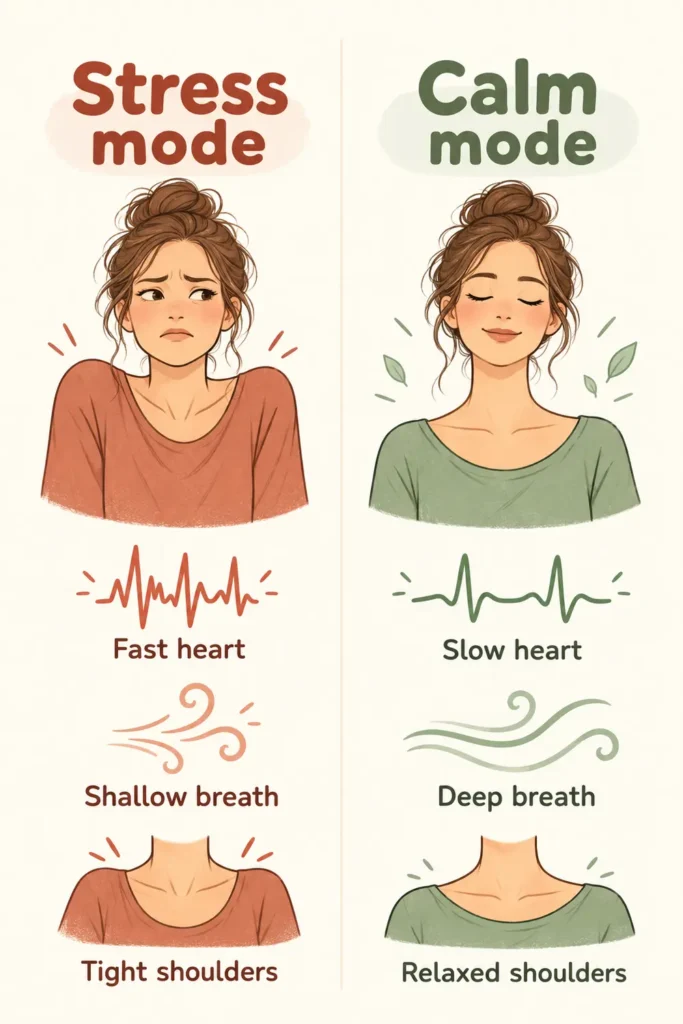
You can’t argue yourself out of stress because stress starts in the body, not in your reasoning. When your brain senses a threat, a deadline, a sharp word, an overflowing inbox, it flips on your sympathetic nervous system, the “fight or flight” mode. Your heart speeds up, your breathing gets shallow and quick, your muscles brace, and the part of your brain that plans and reasons gets quieter.
That’s why being told to “just relax” rarely works. Your thinking brain is not the one in charge in that moment. The way back is to send calm signals from the body up, which switches on the opposite system: the parasympathetic nervous system, sometimes called “rest and digest”.
The four levers you can pull in under five minutes
Every reset in this guide works through one or more of these levers. Knowing them helps you choose the right one in the moment.
- Your exhale. Breathing out is the part of the breath linked to slowing the heart. A long, slow exhale is the fastest calm signal you have.
- Your attention. Stress narrows your focus onto the threat. Bringing your attention to the present moment, through your senses, interrupts the spiral of “what if”.
- Your words. Naming what you feel engages the reasoning part of the brain and turns down the emotional alarm.
- Your body state. A change in temperature, movement or touch tells your nervous system that something has shifted, and gives it permission to settle.
What the research says
Two studies are worth knowing, because they shaped the order of this guide.
In a 2023 randomized study from Stanford published in Cell Reports Medicine, people practised one of three five-minute breathing exercises, or mindfulness meditation, every day for a month. The researchers found that breathwork, and especially exhale-focused “cyclic sighing”, improved mood and lowered breathing rate more than mindfulness meditation, and concluded that daily five-minute cyclic sighing shows promise as a stress-management practice (Balban et al., 2023). That’s why the calming sigh is reset number 1.
A well-known 2007 UCLA brain-imaging study found that putting feelings into words, called “affect labeling”, reduced the response of the amygdala, the brain’s alarm centre, to upsetting images (Lieberman et al., 2007). That’s the science behind reset number 4.
The takeaway is simple and hopeful: calm is a skill, not a personality trait. You can practise it, and it gets faster each time.
Reset 1: The calming sigh (1–5 minutes)
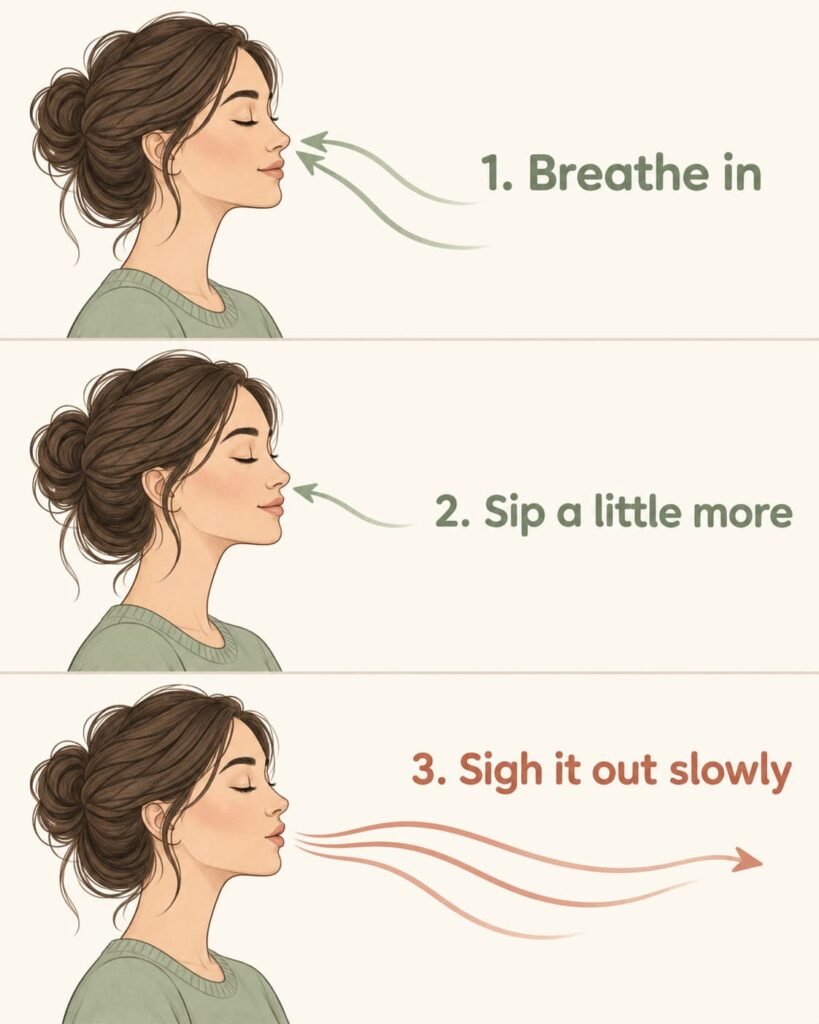
The calming sigh is the fastest way to calm down: two inhales through the nose, one long exhale through the mouth, repeated for one to five minutes. Researchers call it cyclic sighing. You already do a version of it naturally. It’s the deep, shuddering breath after a good cry, or the sigh that escapes when you finally sit down.
How to do it
- Sit or stand comfortably. Let your shoulders drop away from your ears.
- Breathe in slowly through your nose until your lungs feel comfortably full.
- Without breathing out, take a second, shorter sip of air through your nose to top them up.
- Now let it all go through your mouth in a long, slow, unhurried sigh. Make the exhale longer than both inhales together.
- Repeat. Two or three rounds can take the edge off. Five minutes is the version tested in the research.
Mahua’s tip: Don’t rush the exhale. Imagine you’re breathing out through a straw, or gently fogging a mirror. The slower and longer the out-breath, the stronger the calm signal.
Gentle note: If you feel lightheaded, return to normal breathing for a moment. Calm breathing should feel easy, never strained.
Reset 2: Slow-count breathing — 4-7-8 or box (2–5 minutes)
Counting your breath gives an anxious mind a simple job to do, and slows your breathing at the same time. It’s ideal for the moments before something stressful: a difficult call, a presentation, a doctor’s appointment, or lying awake at 2 a.m.
Option A: 4-7-8 breathing (best for winding down and sleep)
- Breathe in quietly through your nose for a count of 4.
- Hold your breath gently for a count of 7.
- Breathe out completely through your mouth for a count of 8.
- Repeat for four rounds to start. Build up slowly over the following days.
If holding for 7 feels uncomfortable, shorten every count (for example 2-3-4) and keep the same rhythm. The long exhale matters more than the exact numbers.
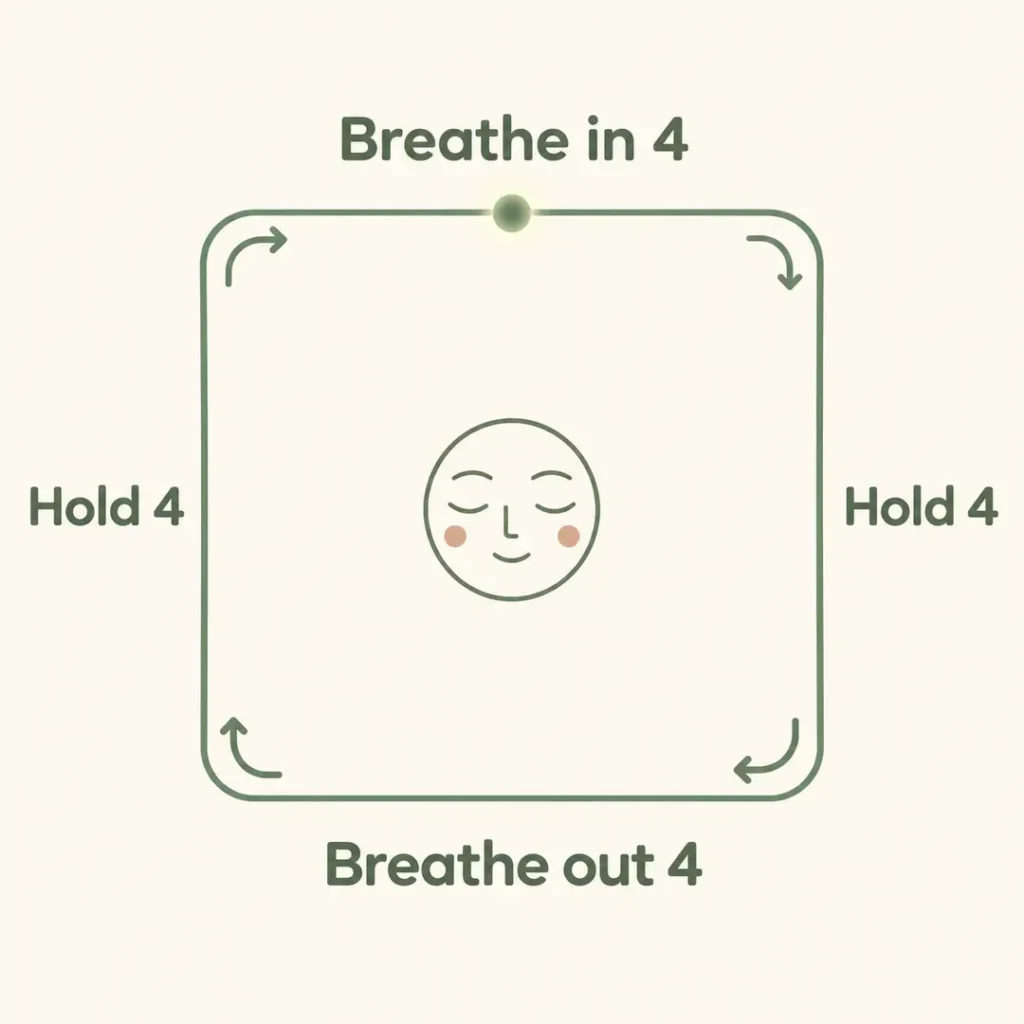
Option B: Box breathing (best for focus under pressure)
- Breathe in for 4.
- Hold for 4.
- Breathe out for 4.
- Hold for 4.
- Trace an imaginary square with your finger as you go, one side per count of four.
Not sure which to choose?
| If you need to… | Try | Why |
|---|---|---|
| Stop a stress spike right now | Calming sigh | Fastest, no counting needed |
| Fall asleep or wind down | 4-7-8 | Longest exhale, slows you down |
| Stay sharp under pressure | Box breathing | Steadies you without making you drowsy |
TRY IT NOW — Mindful Breathing tool
Breathing is easier to follow than to read about. Our free Mindful Breathing tool guides you through a calming breath, step by step, with a gentle visual pacer. Open it in a new tab, press start, and let it count for you.
Start a 2-minute calming breath →
WordPress tip: embed the tool here with your tools shortcode, or use a button block linking to the URL above.
Reset 3: 5-4-3-2-1 grounding (2–3 minutes)
Grounding pulls your attention out of the “what if” spiral and back into the room you’re actually in. When your thoughts are racing ahead to every worst case, your senses are a direct line back to the present moment, where you are, in this moment, okay.
How to do it
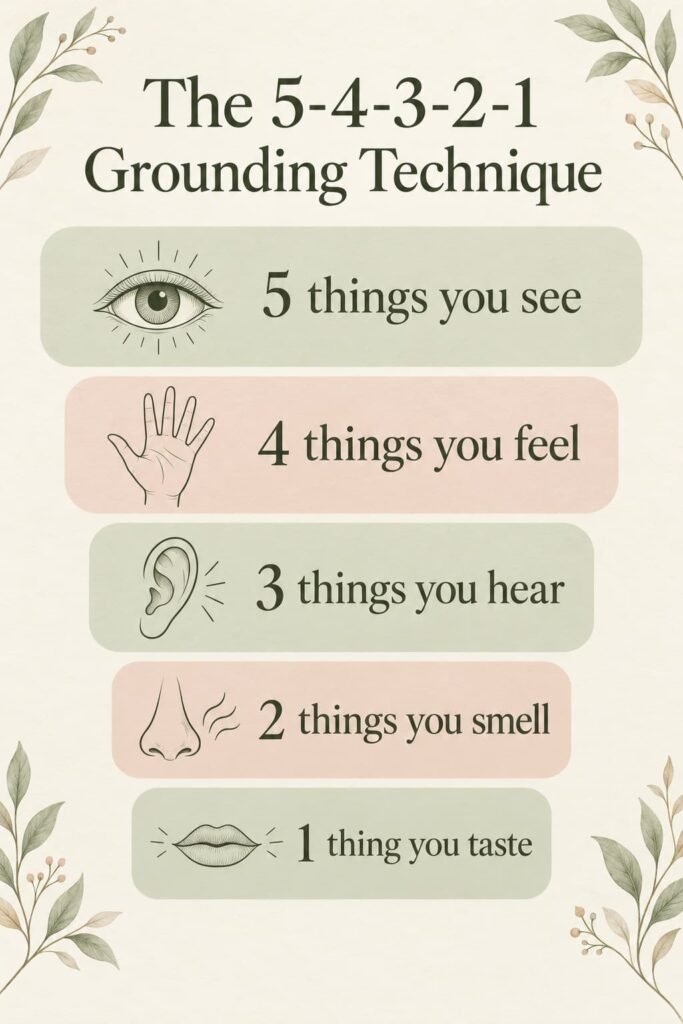
Look around slowly and name, quietly or in your head:
- 5 things you can see — the curve of a mug, the colour of the wall, light on the floor.
- 4 things you can feel — your feet in your shoes, the chair under you, the air on your skin.
- 3 things you can hear — a fan, birds, a distant car, your own breath.
- 2 things you can smell — tea, soap, fresh air. If nothing comes, recall two smells you love.
- 1 thing you can taste — or one kind thing you can say to yourself.
Why it works: Your brain can’t fully attend to an imagined future and to five present details at the same time. Every detail you name is a small vote for here and now.
Best for: racing thoughts, a rising sense of panic, or feeling “not quite in your body”.
Reset 4: Name it to tame it (1–2 minutes)
Naming the exact feeling you’re having turns down its intensity. When emotions feel tangled and huge, they’re hard to handle. Once you give them a name, they become something you’re having, not something you are.
How to do it
- Pause and ask yourself: What am I feeling right now?
- Try to find a precise word. “Bad” is a start, but “disappointed”, “embarrassed”, “overwhelmed” or “dreading” are more useful.
- Say it quietly or write it down: “I’m noticing that I feel overwhelmed.”
- If there’s more than one feeling, name each one. “I feel angry, and underneath it I feel hurt.”
- Add one line of kindness: “Of course I feel this way. This is hard.”
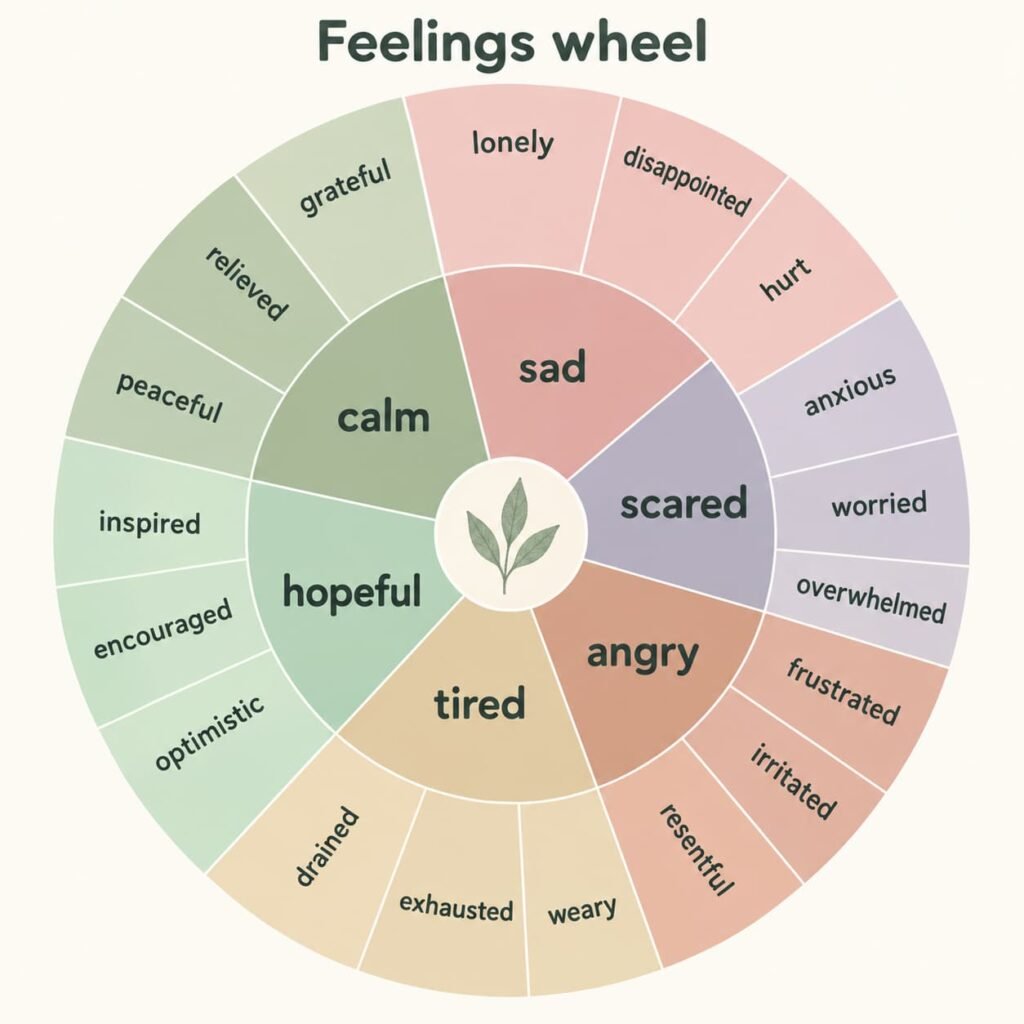
Mahua’s tip: Keep a short list of feeling words in your phone’s notes. On hard days, finding the right word is easier when you can pick from a list instead of searching your mind.
Reset 5: The cool-water reset (1–2 minutes)
Cool water on your face or wrists is one of the quickest physical ways to bring your body down a notch. It works especially well when stress feels hot: a flushed face, a pounding heart, tears close to the surface.
How to do it
- Run the tap until the water feels cool, not icy.
- Splash your face several times, or hold a cool damp cloth over your eyes and cheeks for 20–30 seconds.
- No sink nearby? Hold a cold glass or water bottle against your wrists or the side of your neck.
- Follow it with three calming sighs from Reset 1.
Cool water on the face is thought to engage the body’s natural “dive reflex”, which can help the heart slow down. Even when it doesn’t, the sudden change of sensation interrupts the stress loop.
Gentle note: Use cool, not ice-cold, water. If you have a heart condition or any concerns, speak to your doctor before trying cold-water techniques.

Reset 6: Shake it out, walk it off (3–5 minutes)
Stress fills your body with energy meant for running or fighting, and moving helps that energy go somewhere. If you feel wound up, restless or jittery, sitting still and breathing may not be enough. Your body wants to move first.
Three ways to do it
- The 60-second shake: Stand up and gently shake out your hands for 20 seconds, then your arms, then your legs one at a time. Finish with a big shoulder roll and a calming sigh.
- The stairs or corridor walk: Walk briskly for three to five minutes, ideally somewhere with a window or outside. Let your arms swing.
- The wall push: Place your palms on a wall and push firmly for 10 seconds, then release. Repeat three times. It gives tense muscles something to do, then lets them let go.
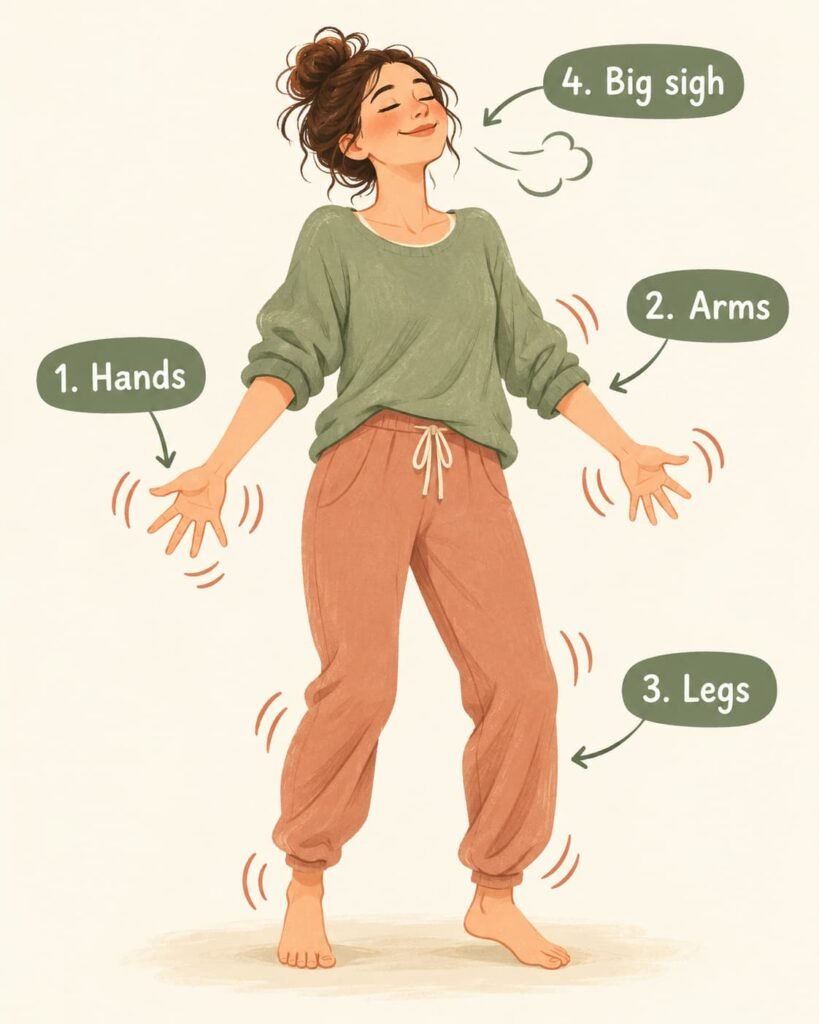
Best for: feeling wound up after an argument, too much caffeine, or a long stretch at a desk.
Reset 7: The soothing hand (1–3 minutes)
Gentle, supportive touch is one of the simplest ways to feel safe in your own body. It’s the self-care version of being held by someone who loves you. It sounds small. It isn’t.
How to do it
- Place one hand over your heart and the other on your belly, or cup your own cheek, or hug your arms across your chest. Choose whatever feels natural.
- Feel the warmth of your hands. Notice the gentle rise and fall of your breath underneath them.
- Say something kind to yourself, the way you would to a close friend: “This is a hard moment. I’m doing the best I can. I’m allowed to go slowly.”
- Stay for a few breaths, or as long as it feels good.

Best for: moments when you’re being hard on yourself, feeling lonely, or after a difficult conversation.
FREE: The Calm Companion
Keep these resets within reach, even offline. The Calm Companion is our free printable guide with the seven resets on one page, a pocket card for your bag, feeling-word prompts, and a gentle space to note which resets work best for you.
Stick it on your fridge, keep it by your desk, or save it on your phone for the next time stress shows up unannounced.
Download the Calm Companion — free →
Replace this URL with your actual Calm Companion opt-in page before publishing.
Your 5-minute calm plan for real-life moments
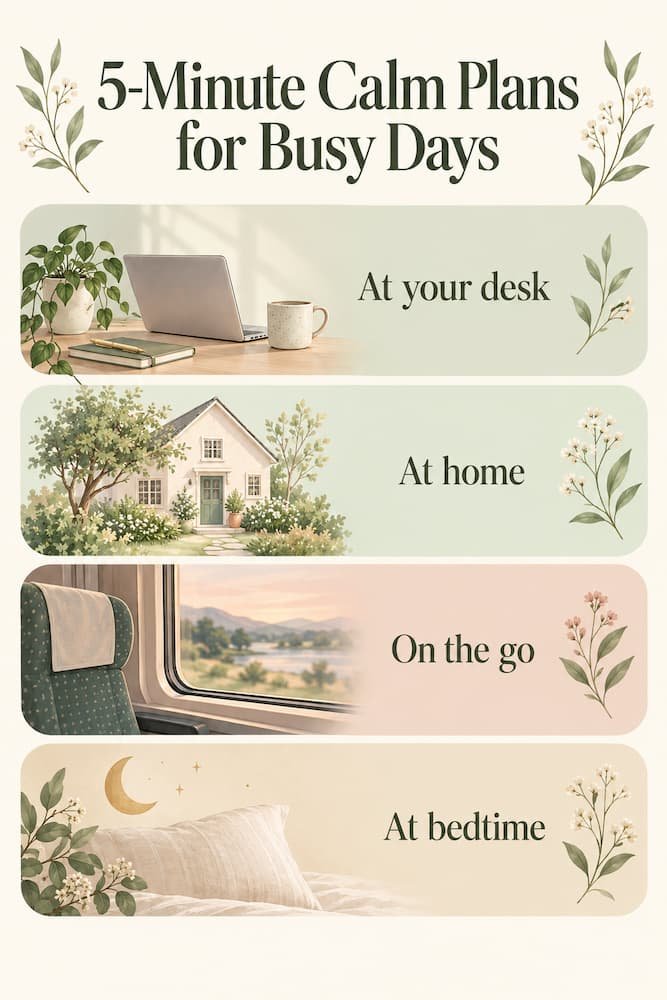
The best reset is the one that fits where you are. You can’t splash your face in a meeting or shake out your arms on a crowded train. Here are ready-made five-minute combinations for the moments that most often catch us off guard.
| Where you are | Minute 0–2 | Minute 2–4 | Minute 4–5 |
|---|---|---|---|
| At your desk, before a hard meeting | Box breathing, eyes on one fixed point | 5-4-3-2-1 grounding, silently | Name the feeling, then one kind sentence |
| In a meeting or on a call (no one can tell) | Slow calming sighs through the nose, long quiet exhale | Feel both feet on the floor, press gently | Rest one hand on your lap or chest |
| At home, kids melting down | Step to the sink: cool water on wrists | Three calming sighs, slower than theirs | Soothing hand, then go back in calmer |
| On a train, bus or in traffic | 5-4-3-2-1 grounding with the window view | Calming sigh, eyes softly lowered | Name it: “I feel rushed, and I’m safe” |
| In bed, mind racing at night | 4-7-8 breathing, four rounds | Soothing hand on heart and belly | Let the breath return to normal and rest |
| After an argument | Shake it out or walk for 3 minutes | Calming sighs | Name it to tame it, in writing if you can |
Build your personal calm kit
The goal isn’t to remember all seven resets in a crisis. It’s to have two or three you trust so well they become automatic. Stress makes it hard to think, so you want your calm tools ready before you need them.
A gentle 7-day trial
Try one reset a day for a week, at a calm moment, so your body learns it before you need it.
- Day 1: The calming sigh, three rounds after breakfast
- Day 2: 4-7-8 breathing, in bed before sleep
- Day 3: 5-4-3-2-1 grounding, on your commute or a walk
- Day 4: Name it to tame it, at the end of the work day
- Day 5: The cool-water reset, mid-afternoon
- Day 6: Shake it out, after sitting for a long stretch
- Day 7: The soothing hand, before you fall asleep
At the end of the week, ask yourself: Which two felt most natural? Which one surprised me? Those are your calm kit.
Mahua’s tip: Pair each of your favourites with something you already do every day, such as waiting for the kettle, stopping at a red light, or washing your hands. The habit you already have becomes the reminder for the new one.
Not sure what kind of stress you’re carrying?
Sometimes we reach for calming techniques when what we really need is rest, a boundary, or a conversation. Our free Stress Check takes about two minutes and helps you see how much you’re carrying right now, and What Self-Care Do You Need Today? suggests the kind of care that fits your day.
When five minutes isn’t enough
These resets are first aid for stressful moments. They’re powerful, and you can use them for the rest of your life. But if you find yourself needing them several times a day, most days, that’s your body telling you something deeper needs attention: the pace of your life, how you sleep, what you carry for everyone else, or how rarely you get to put it down.
That’s the work our premium guides are made for.
GO DEEPER — Premium self-care guides
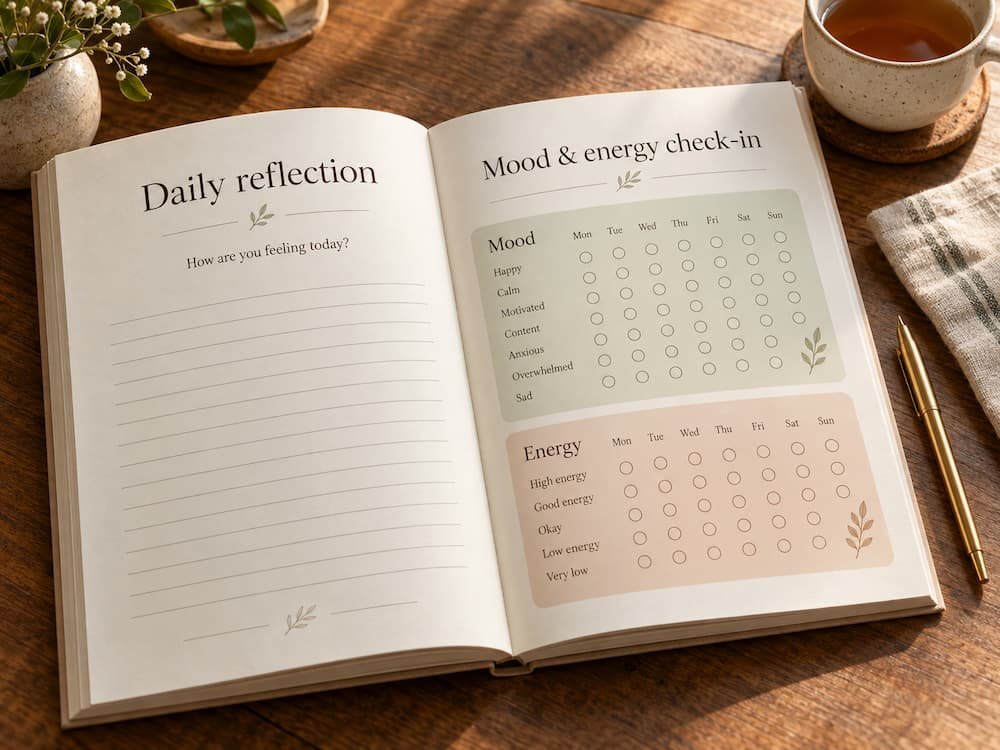
If you’re ready to move from getting through stressful moments to building a calmer life, our premium guides walk with you day by day. Each one includes daily reflective prompts, mood and energy check-ins, weekly gentle reviews, and simple calming practices you can keep coming back to.
They’re beautifully designed, printable, and written to feel like a kind friend beside you, not another thing on your to-do list.
Swap in the specific stress-related premium guide and its product link when it’s live.
When to reach out for support
Self-care resets are for everyday stress; they’re not a replacement for professional care. Please talk to a doctor, counsellor or someone you trust if:
- you feel anxious or on edge most days, for weeks at a time
- stress is affecting your sleep, appetite, work or relationships
- you have sudden episodes of intense fear with a racing heart, chest tightness or trouble breathing (if you’re ever unsure, seek medical help straight away)
- you’re relying on alcohol, food or other substances to cope
- you have thoughts of harming yourself
If you’re in crisis or feel unsafe, please contact your local emergency number or a crisis helpline in your country right now. Reaching out is not a failure of self-care. It is self-care.
Frequently asked questions
How can I calm down in 5 minutes?
Start with two to three minutes of calming sighs: a full inhale through the nose, a short top-up inhale, then a long slow exhale through the mouth. Then spend one minute on 5-4-3-2-1 grounding and finish by naming how you feel. For most people, this combination noticeably lowers stress within five minutes.
What is the fastest way to calm down?
A long, slow exhale is the fastest calming signal you can send your body. One to three calming sighs can take the edge off in under a minute. If you feel hot and flushed, cool water on your face or wrists is another very quick option.
How do I calm down when I’m overwhelmed and can’t think?
Don’t try to think your way out first. Start with your body: lengthen your exhale, feel your feet on the floor, and press your palms together. Once your breathing slows, your thinking brain comes back online, and then you can name the feeling and decide on one small next step.
Is 4-7-8 or box breathing better for stress?
Both help. 4-7-8 breathing has a longer exhale, which makes it especially good for winding down and falling asleep. Box breathing keeps you steady and alert, which makes it better before a meeting, an exam or a difficult conversation.
Can I calm myself down without anyone noticing?
Yes. Slow calming sighs through your nose are almost silent. You can also do 5-4-3-2-1 grounding in your head, press your feet gently into the floor, or rest one hand on your lap. Nobody in the room needs to know.
Why do breathing exercises work for stress?
Slow breathing, particularly a long exhale, activates the parasympathetic nervous system, the body’s rest-and-digest mode. In a 2023 Stanford study, five minutes a day of exhale-focused cyclic sighing improved mood and lowered breathing rate more than mindfulness meditation.
How often should I practise calming techniques?
A few minutes a day, at calm moments, is ideal. Practising when you’re already relaxed teaches your body the pattern, so it’s much easier to use when stress actually hits.
A last word from Mahua
Stress will keep visiting, because you care about things, because life is full, because you’re human. The aim was never to stop feeling it. It’s to know, deep down, that you can come back to yourself. Every time you take a slow breath on purpose, you’re telling your body: I’ve got you.
Save this page, or pin it, so it’s here the next time you need it. And come back often. We publish new gentle guides every week.
With care, Mahua

Keep reading
- How to Manage Everyday Stress Gently: A Self-Care Guide for Busy Women — our complete stress guide (coming soon)
- 4-7-8 and Box Breathing: Two Breathing Exercises for Stress (coming soon)
- What to Do When Everything Feels Like Too Much (coming soon)
- Self-Care When You Have No Time: 10 Micro-Moments (coming soon)
Sources
- Balban MY, et al. (2023). Brief structured respiration practices enhance mood and reduce physiological arousal. Cell Reports Medicine, 4(1), 100895.
- Lieberman MD, et al. (2007). Putting feelings into words: affect labeling disrupts amygdala activity in response to affective stimuli. Psychological Science, 18(5), 421–428.
This article is for general wellbeing information and is not medical advice. Please read our Medical Disclaimer and consult a qualified professional about your own health.







1 reflection from readers
A kind space to share what helped, what you tried, or a question. Comments are read before they appear.
nice article